Engaging and Educational: How Word Search Kids Activity for KDP Vol-17 Supports Learning Through Play
Finding meaningful activities that captivate a child's attention while quietly building essential skills can feel like a constant search. Parents, teachers, and caregivers often look for resources that strike a balance between entertainment and learning. A word search puzzle delivers exactly that kind of dual benefit, and a carefully curated collection like Word Search Kids Activity for KDP Vol-17 provides a ready-made solution that fits neatly into busy schedules and diverse learning environments. The timeless appeal of hunting for hidden words in a grid of letters has made this activity a staple in classrooms and homes for decades, and for good reason. It engages the brain, encourages pattern recognition, and offers a satisfying sense of accomplishment with every completed puzzle.
What Makes Word Search Puzzles a Lasting Favorite for Kids
At its core, a word search puzzle presents a simple challenge: find a list of hidden words buried within a seemingly random assortment of letters. The words can appear horizontally, vertically, diagonally, and sometimes backward, requiring the solver to scan carefully in multiple directions. This straightforward concept contains surprising depth. As children work through each puzzle, they practice visual scanning, develop concentration stamina, and reinforce spelling patterns without the activity ever feeling like a chore. The format naturally encourages patience and attention to detail, qualities that serve kids well across all areas of learning.
The appeal also lies in its accessibility. A child does not need extensive instructions or adult guidance to get started. Once they understand the basic rules, they can work independently, making it an excellent choice for moments when a parent or teacher needs a productive, self-directed task. The puzzles in Word Search Kids Activity for KDP Vol-17 honor this tradition while adding thoughtful design choices that make the experience smoother for both children and the adults facilitating the activity.
Understanding the Need for Varied and Well-Organized Puzzle Collections
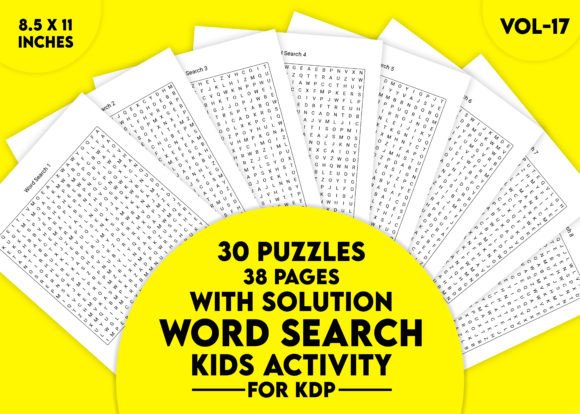
One of the persistent challenges adults face when sourcing puzzles for kids is finding a collection that offers enough variety to sustain interest without becoming overwhelming or repetitive. A handful of puzzles might entertain for a day or two, but they quickly run out. Conversely, a massive, unstructured book can feel daunting. The structure of Word Search Kids Activity for KDP Vol-17 addresses this need directly by offering 30 distinct puzzles that span a range of themes and difficulty levels. This quantity hits a sweet spot: it is substantial enough to provide weeks of regular use, yet contained enough to feel completable, giving children a tangible goal to work toward.
Another practical consideration is format. Loose puzzle pages can get lost, and poorly formatted grids strain young eyes. The 8.5 by 11-inch dimensions chosen for this volume ensure that each puzzle sits on its own page with ample space for letters to be clearly read. This single-puzzle-per-page layout reduces visual clutter and allows kids to focus entirely on the task at hand. There is no flipping back and forth to find the word list, no squinting at tiny text, and no distraction from adjacent puzzles. For adults, this also means the pages can be easily photocopied for classroom use or shared among siblings without arguments over who gets which page.
How Thoughtful Design Choices Enhance the Solving Experience
Every detail in a puzzle book made for children matters. Font size, grid density, and the arrangement of solutions all contribute to whether the resource becomes a go-to favorite or a source of frustration. In Word Search Kids Activity for KDP Vol-17, the inclusion of solutions is handled with particular care. Rather than burying answer keys in the back without clear organization, this volume places four solutions on a single page. This compact yet legible format makes it easy for kids to check their own work or for a parent to quickly verify an answer without searching through dozens of pages. Encouraging self-checking fosters independence and helps children learn from any mistakes they make, turning each puzzle into a genuine learning opportunity rather than just a test of skill.
The ready-to-use PDF format adds another layer of practicality. Teachers can print exactly what they need for a class of students. Parents can reprint favorite puzzles for road trips or rainy afternoons without worrying about running out. The digital nature of the product means it can travel across devices, always available when a quiet, screen-free activity is called for. This flexibility supports a wide range of situations, from structured lesson plans to spontaneous moments of downtime.
Practical Applications in Everyday Settings
The versatility of word search puzzles means they fit naturally into many different contexts. For families, these puzzles make excellent additions to morning routines, providing a calm, focused start to the day. They work equally well as after-school wind-down activities, giving children a break from screens while keeping their minds gently engaged. During travel, whether by car, plane, or train, a printed puzzle page offers entertainment that requires no power, no internet connection, and no cleanup.
In educational settings, teachers often use word searches to reinforce vocabulary from science, history, or language arts units. The thematic variety found in this collection supports such cross-curricular connections. A puzzle centered on animals might complement a biology lesson, while one built around geography terms could bolster a social studies unit. Because the words are hidden in multiple directions, students naturally practice the kind of careful reading that benefits their performance on tests and written assignments. The puzzles also serve as effective quiet work for early finishers, keeping the classroom productive without requiring constant teacher intervention.
For homeschooling families, Word Search Kids Activity for KDP Vol-17 integrates seamlessly into daily learning rhythms. It can be used as a warm-up exercise, a break between more intensive subjects, or a rewarding activity after a focused work session. The varying difficulty levels accommodate siblings of different ages and abilities, allowing a single resource to serve multiple children. This kind of adaptability reduces the need to purchase and manage separate materials for each child, which is a significant practical advantage for families with limited time and budgets.
Supporting Different Learners and Approaches
Not all children approach puzzles in the same way. Some are methodical, scanning row by row with disciplined precision. Others take a more intuitive path, letting their eyes wander until a familiar letter pattern jumps out. Both styles are valid, and both benefit from regular puzzle practice. The first approach builds systematic thinking and persistence, while the second develops pattern recognition and flexibility. The puzzles in this volume accommodate these different styles by offering a mix of word lengths and placement directions. A child who struggles with horizontal searches may discover they have a knack for spotting diagonal or backward words, and that discovery builds confidence that transfers to other challenges.
For children who find reading or spelling particularly difficult, word searches provide a low-pressure way to engage with letters and words. The focus on finding rather than producing words removes the stress of spelling tests and writing exercises. Over time, repeated exposure to correct spellings within the puzzles reinforces orthographic knowledge. Kids begin to internalize common letter combinations and word structures, often without realizing they are learning. The solution pages then allow them to confirm their accuracy, closing the feedback loop in a satisfying and non-judgmental way.
Building Long-Term Habits Through Enjoyable Practice
One of the most valuable outcomes of consistent puzzle use is the development of a growth mindset. When a child cannot immediately find a word, they learn to keep looking rather than give up. They discover that persistence pays off, and that challenging tasks become easier with practice. This lesson extends far beyond puzzle grids. The puzzles in Word Search Kids Activity for KDP Vol-17 are designed with this gradual progression in mind. Easier puzzles allow beginners to experience success quickly, building the confidence to tackle harder ones. The variety of themes keeps the experience fresh, so children remain curious about what the next puzzle will bring.
The print-ready nature of the PDF also means that kids can take ownership of the experience. They might choose which puzzle to do next, create a folder of completed pages to track their progress, or even compete gently with siblings or classmates to see who can complete a puzzle fastest. These small elements of choice and friendly challenge increase engagement and make the activity feel personal rather than assigned.
Making an Informed Choice for Your Young Learners
When selecting a puzzle resource, adults will naturally consider factors like age appropriateness, ease of use, and overall value. Word Search Kids Activity for KDP Vol-17 addresses these considerations through its clear formatting, sensible page design, and inclusion of solutions. The 30-puzzle count provides ample material without excessive repetition, and the PDF format offers immediate access and unlimited prints. For teachers managing classrooms, parents juggling multiple responsibilities, and caregivers looking for reliable, quiet activities, this collection represents a practical, ready-to-implement tool.
Ultimately, the goal is to give kids an activity they genuinely enjoy while quietly supporting their cognitive development. Word searches achieve this balance beautifully. They ask children to focus, think critically, and persist in the face of challenge — all within the context of a game. By choosing a well-crafted volume like this one, you equip your young learners with more than just a set of puzzles. You give them a resource that builds skills, confidence, and a healthy relationship with effort and problem-solving, one hidden word at a time.
